












Autism largely affects children worldwide. Parents are concerned and want to ensure their kids are safe from this issue. In this article, we’ll discuss the top 10 behaviour analysis and autism questions that every parent should ask their children to make sure of their safety.
Diagnosing autism at an early stage is not always easy. Asking difficult behaviour analysis and autism questions too soon can sometimes create a negative experience for both the child and the caregiver. You might have heard that Applied Behaviour Analysis is one of the leading approaches to support autistic children, but you may also have come across worrying or conflicting articles about it. This can make it hard to know what is truly effective and evidence-based.
You don’t have to worry. In this discussion, we have gathered about 10 key behaviour analysis and autism questions to guide you. We will also highlight the latest research from 2025 and 2026 to show how these therapies are becoming more effective. You will gain insight into the core reasons behind neurodivergence and its impact on behaviour.
NOTE: This article is written with the support of experts at The Academic Papers UK, a trusted dissertation writing service. It will help you clear the fog by offering evidence-based questions and practical guidance.
Let’s explore more below:
What Is Applied Behaviour Analysis (ABA) and How Does It Help Individuals with Autism?
According to the Merriam Webster Dictionary, “Applied Behaviour Analysis is psychological therapy that uses techniques developed from the objective analysis of observable behaviour to make changes to socially significant behaviours.”
It is a scientific discipline that focuses on understanding the relationship between the environment and the way an individual behaves in different situations. You can think of it as a methodical way of looking at what happens before a child does something.
According to NHS England (12 February 2026), there were 254,108 patients with an open referral for suspected autism in December 2025. This massive number of people waiting for help shows why it is so important to have structured and autism behaviour intervention. This means you can start to see patterns in your child’s daily life that you might have missed before. You can begin to understand why certain times of the day are more difficult. This is a very proactive way of parenting.
Top 10 Behaviour Analysis and Autism Questions Every Parent Has
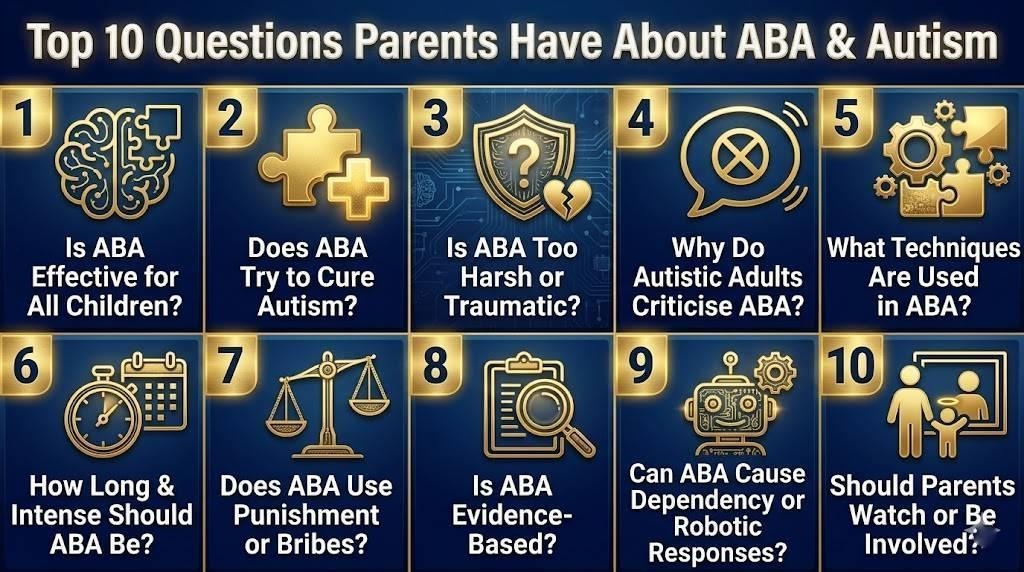
You likely have a long list of questions that you want to ask when you first hear the term behavioural therapy. Some of these questions might feel a bit difficult to ask. However, you must know them. A list of such behaviour analysis and autism questions is given below:
1. Is ABA Therapy for Autism Effective for All Children with Autism?
Whether any therapy is a one size fits all solution is a very important question for you to consider. What works wonders for one child might not be the right fit for another and that is perfectly okay. The effectiveness of the programme often depends on the quality of the therapist and how well they can adapt the techniques to your child’s interests.
- Behavioural analysis in autism is particularly effective for teaching foundational skills like communication and self-care.
Parental involvement is one of the biggest predictors of success, as it allows the skills to be practised consistently throughout the day.
- High quality programs with active data tracking and parent coaching often work better than just more behaviour therapy for autism.
2. Does ABA Try to Cure Autism or Make Kids Normal?
The idea that autism is something that needs to be cured is deeply outdated. You will find that modern therapists view autism as a neurological difference rather than a disease. According to a National Autistic Society policy (2025), the support should never try to make someone less autistic because that is impossible and wrong. Here are some helpful tips:
| Goal Category | Outdated Approach | Modern UK Approach |
| View of Autism | A disorder to be treated or cured | A neurodivergent identity to be respected |
| Success Metric | Appearing normal or neurotypical | Improved quality of life and autonomy |
| Social Skills | Forcing eye contact and standard social cues | Teaching functional communication and self-advocacy |
| Choice | Compliance with adult instructions | Promoting child assent and the right to say no |
3. Is ABA Too Harsh or Traumatic?
You might have read some truly heartbreaking stories about autism intervention using ABA. It is important that you know that those practices are not representative of high-quality modern therapy. The industry has undergone a massive shift now. The beauty is that modern UK therapists are now being trained in trauma-informed care, which means they always prioritise your child’s emotional well-being.
- Modern ethical guidelines in the UK are incredibly strict about how therapists must behave to protect children.
- Therapists should look for child assent, which means the child shows that they are happy to participate.
- The use of aversion therapy or physical punishments has left a lasting scar on the community and is not allowed.
To understand how evidence is gathered and evaluated, see this guide to commonly used methods in social science research.
4. Why do Some Autistic Adults Criticise ABA?
It is really important for you to listen to the voices of the people who actually have the lived experience of being autistic. Many autistic adults describe their childhood experiences with behavioural therapy as a process of being forced to mask their true selves to please others.
This masking can lead to severe mental health issues. This tension shows that we must listen carefully to these concerns to build better support systems for future generations.
5. What Techniques are Used in ABA for Autism?
You will find that modern behavioural support uses a diverse range of techniques. A list of such issues is mentioned below:
| Technique Name | Primary Purpose and Focus | Level of Structure |
| Discrete Trial Training (DTT) | Breaking down complex skills into small, clear steps for early learning | Highly structured and adult-led |
| Natural Environment Teaching (NET) | Teaching skills during play and everyday activities to help them transfer | Very flexible and child-led |
| Pivotal Response Treatment (PRT) | Targeting core areas like motivation and self-initiation | Naturalistic and play-based |
| Verbal Behaviour Intervention (VBI) | Focusing on the functional use of language to get needs met | Semi-structured and communication-focused |
| Functional Behaviour Assessment (FBA) Assessment | Identifying the root causes and triggers of challenging behaviours | Analytical and data-driven |
6. How Long and Intense Should ABA Be?
This is one of the most debated topics in the entire field of autism. In the past, early intensive autism behavioural treatment programs often recommended 30 to 40 hours of therapy a week. That is not all as you also need to think about the long-term sustainability of the program for your whole family.
If you are paying for private therapy, the costs can be astronomical over several years and lead to significant financial hardship for parents. It is often better to have a lower intensity program that you can maintain for a long time.
7. Does ABA Use Punishment or Rewards that Feel like Bribes?
It is common for parents to worry that using rewards like stickers or small toys is just bribery. However, there is a big difference between a bribe and positive reinforcement in a clinical setting. A bribe is usually given before a behaviour to get someone to do something they do not want to do while reinforcement is given after a skill has been demonstrated to help the brain remember it.
8. Is ABA Evidence-Based?
When you hear that a therapy is evidence-based, it means that many scientific studies have been conducted to determine whether it actually works. Applied Behaviour Analysis autism is one of the most researched of all autism interventions. However, it is also true that there are gaps in the research, especially when it comes to the long-term mental health of the people who receive the therapy.
9. Can ABA Cause Dependency or Robotic Responses?
You might have seen videos of children responding to behaviour analysis and autism questions in a very stiff or monotone way. This robotic response usually happens when a child has been taught in a very rigid way. This is why the best programmes place a huge emphasis on generalisation.
According to a research review by NeuroSpace ABA published on 18 August 2025, high-quality programmes with active data tracking and parent coaching often work better than just more therapy time. This means that the focus should always be on helping your child become a spontaneous and flexible communicator.
10. Should Parents Watch Sessions or Be Involved?
Yes, you should definitely be involved in your child’s behaviour analysis autism therapy as much as you possibly can. In fact, many of the most successful modern programmes are built entirely around parent coaching. You are the expert on your child, and you are the person who is there for the real life moments.
The therapist is there to just give you the tools but you are the one who will use them every day. Plus, parents who are also students or educators often rely on essay writing services to keep up with their coursework. This allows them to dedicate their full attention to understanding and supporting their child’s therapeutic journey.”
Many students like to study behaviour analysis and autism because it helps answer questions that parents often find hard to ask. They learn how ABA therapy for autism works and how it can help kids in real life. When students write about this topic, they also hire dissertation writing services in the UK to help them organise their research and explain things clearly. This support lets them focus on learning about autism and behaviour therapy while making sure their work is correct and easy to understand.
Conclusion
Applied Behaviour Analysis is a complex and evolving field that offers many practical behaviour assessment tools for autism for supporting autistic children. While the history of the therapy has caused some valid concerns, UK practitioners are increasingly moving toward a more holistic approach.
The above 10 behaviour analysis and autism questions help students recognise and support their autistic child. You have the right to be fully involved in every decision about your child’s support and to make sure that their dignity and happiness are always the top priority.
Frequently Asked Questions About Behaviour Analysis and Autism
Most scientists today believe that between 60 per cent and 90 per cent of the risk for developing autism is linked to our genetics. This means that if you have one autistic child, there is a higher chance that your other children or relatives might also be on the behavioural therapy autism spectrum disorder. Environmental influences, such as prenatal exposures or advanced parental age, also play a role.
The 6-second rule is a really simple but incredibly powerful communication trick. It basically means that after you ask your child a question, you should count slowly to 6 in your head before you say anything else. This silent pause gives your child’s brain the extra time it needs to process the language and figure out how to respond without feeling rushed or pressured.
These are 3 main symptoms of autism in children:
1. Challenges with Social Communication
2. Repetitive Behaviours and Intense Interests
3. Sensory Processing Differences
Managing them in a timely manner can improve their issue. However, remember that autism can’t be treated, though it can be greatly reduced.