






Starting an automated retail route can be a great way to generate passive income, but treating it like a set-and-forget hobby is the fastest way to burn cash.
The reality is that each automated kiosk you place is a miniature version of a traditional brick-and-mortar store.
It has its own direct cost of goods sold, point-of-sale processing fees, regional lease expenses, and logistical depreciation
If you are weighing the best vending machines to invest in for a new business, you can’t just look at total sales numbers.
Moreover, you need to dissect the underlying unit economics of the most profitable vending machines.
Let’s unpack how modern design, product margins, and smart infrastructure combine to create a highly sustainable, cash-generating business model.
The Structural Realities Of Automated Retail Margins
To build something truly sustainable, you need to understand the difference between gross sales and net take-home profit.
Most aspiring operators get hypnotized by flashy social media clips that show thousands of dollars being vacuumed out of a bill validator.
What those videos do not show is the slow decay of capital from wholesale inflation, gas money to restock, credit processing fees, and location commissions
According to data compiled by the National Automatic Merchandising Association (NAMA), traditional convenience service structures typically generate a gross margin between 40% and 60%.
Furthermore, your final net margin, the money that actually hits your corporate bank account, usually falls between 15% and 30% after subtracting all operational overhead.
Your machine’s structural design also dictates your product options, which sets your baseline cost structure.
Let’s dissect the performance of the core asset classes currently in the marketplace.
The Most Profitable Vending Machines In 2026
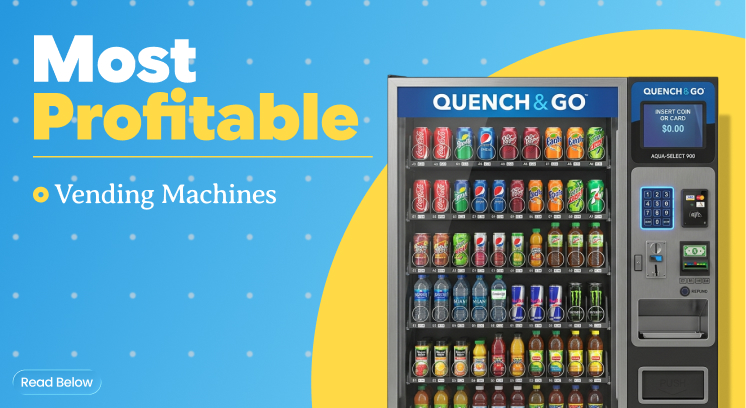
In 2026, here are the most profitable vending machines you can run.
Automated Cold Beverage Kiosks
Beverage distribution remains the huge bedrock of the global unattended retail ecosystem.
Industry intelligence shows drink machines account for over 40% of standard market operations.
The reason is simple: universal human thirst creates non-cyclical, consistent demand patterns across all four seasons.
1. The Financial Breakdown
The specific beverage choice heavily dictates the individual margin profile. Data from Market.us Vending Industry Metrics shows a stark divergence in individual unit performance:
- Bottled Water
Yields the single highest per-unit margin at roughly 86%. A standard bottle bought wholesale for $0.25 can easily retail for $2.00 at an athletic center or transit hub.
- Energy Drinks
They generate a lower per-unit percentage margin of around 43% but offer substantially higher absolute dollar revenue per transaction.
A premium energy drink retailing at $4.50 keeps more net cash per transaction than a cheap bottle of water.
- Isotonic Sports Drinks
These strike a strong middle ground, pulling a 60% gross margin when positioned inside private gyms, basketball courts, or indoor soccer complexes.
2. Real-World Operational Example
Imagine deploying a modern, glass-front drink machine in a corporate manufacturing plant break room.
If the unit completes 40 transactions a day at an average ticket price of $2.50, it generates $100 in daily gross volume.
With an average beverage COGS of 50%, your daily gross profit sits at $50. After a 15% location commission to the factory owner and 4% in cashless payment processing fees, your true daily net take-home is roughly $31. Over a standard operational month, this single machine nets a reliable $930.
On-Demand Bean-To-Cup Coffee Systems
If your primary operational goal is to maximize the raw percentage margin on every transaction, hot beverage dispensing systems are hard to beat.
Coffee machines are among the most profitable vending machines.
They function as active preparation systems rather than passive holding boxes.
| Metric | Pre-Packaged Snack/Soda | Bean-to-Cup Coffee Kiosk |
|---|---|---|
| Average Gross Margin | 40% – 50% | 60% – 70% |
| Base Component Cost | High (Finished product wholesale) | Very Low (Raw beans, water, paper cup) |
| Average Retail Price | $1.50 – $2.50 | $3.00 – $5.00 |
| Operational Risk | Product expiration/stale date | Mechanical scaling/cleaning needs |
Why The Economics Work
When you sell a bag of chips, you’re selling a finished product that has come from a warehouse.
You pay for the plastic packaging, production costs, and delivery services. This inherently limits your margin.
By contrast, a hot coffee machine purchases its inputs at a fraction of the price. A combination of bulk espresso beans, water, powdered milk, and a paper cup go into making a premium vanilla latte.
In some cases, the ingredient cost for one such beverage might range from $0.20 to $0.50.
Consumers will happily pay $3.00 to $5.00 for a cup of fast coffee, and gross margin often exceeds 70% per cup.
The Hidden Operational Trade-Off
Don’t buy a coffee kiosk and expect to make serious money if you’re not prepared for some hands-on work.
These machines contain complex internal mixers, grinders, and heating coils.
If you are buying water from a municipal source with high calcium levels, scale buildup will appear in your hot water lines and cause mechanical failures.
You must also clean and sanitize coffee bean bins and milk powder tubs weekly to prevent contamination and maintain freshness.
The higher your gross margin, the more effort you must invest in upkeep.
Fresh Food And Smart Micro-Markets
Modern consumer patterns have shifted towards healthy eating.
The snack spiral, with its high-fructose corn syrup bars, is seeing fewer and fewer sales in the professional sphere.
Furthemore, that’s why fresh-food smart vending machines are among the most profitable.
This has spurred the development of fresh-food smart vending machines and micro-market coolers.
1. Understanding Smart Coolers
A micro-market system employs a smart cooler in a non-traditional configuration.
Instead of a coin lock and mechanical drop coil, customers use a credit card or mobile payment method to gain access.
After opening the machine’s glass door, the consumer can physically inspect the fresh turkey wrap and its ingredients.
Then, the door can be closed and reopened to return an unwanted product.
Smart cameras and weight sensors keep an automated ledger of what has been taken and immediately charge the customer’s card.
Moreover, industry insiders at development firms report that smart micro-markets eliminate many of the operational inefficiencies of traditional vending.
2. Managing The Perishable Inventory Risk
While specialty salads, fruit cups, and sandwiches can bring in ticket prices of $7.00 to $12.00 per item, they also pose a serious spoilage risk.
- A bag of chips has a shelf life of many months in a metal spiral.
- A fresh chicken Caesar salad will wilt and stink after 5 days on the machine.
If your routing is disorganized and you throw away 15% of your total inventory because it expires, your overall margins will take a severe beating.
Moreover, the fresh food space demands a serious commitment to route optimization and software to track product expiration.
Specialized Niche And Specialty Kiosks
In some cases, a vending machine route that forgoes traditional foods altogether can be much more profitable.
Moreover, these specialty kiosks target specific demographics and can command extreme markups because of low saturation.
Nightlife And Hospitality Deployments
Deploying specialty, space-saving cabinets at bars, nightclubs, and concert venues creates highly lucrative opportunities.
Operators in this space report that the best vending machine for bars carries products tailored to its patrons.
- Mini power banks priced at $2.50 wholesale easily fetch $13.00 and sell at extraordinary margins at 1:00 AM, when a nightclub patron’s phone battery hits 2%.
- Vapes and cartridges are often marked up more than 70% from wholesale.
- “Mystery bag” impulse items generate surprising revenue.
High-End Automated Beauty and Electronics
Another fast-growing specialty niche involves selling premium cosmetics or electronics at upscale gateway locations.
Kiosks operated by major brands prove that desperate travelers will pay shocking prices for simple self-care.
Higher ticket prices for beauty and electronics mean a single automated retail machine can generate the equivalent of 5 traditional soda vending machines while taking up far less space.
- Firstly, makeup palettes cater to travelers who want to freshen up before landing.
- Secondly, noise-canceling earbuds become a necessity for would-be nappers on long-haul flights.
- Thirdly, international power adapters generate strong margins for anxious travelers who forgot their charging brick at home.
Golden Rules for Maximizing Real-World Profitability
Following these three real-world rules will keep your vending machine route in the top 10% of profitability in the region.
1. Location Traffic Is Paramount
First, location drives at least 75% of your total revenue. Even the smartest kiosk can’t overcome an undesirable location.
Seek out large facilities that see traffic flow throughout the day:
- Factories and manufacturing plants that employ a rotating shift system
- Metro stations or bus terminals with a high volume of passengers
- Hospital waiting rooms and staff break areas
- College dorms and large housing developments
2. Cashless Telemetry Systems Are a Must
Secondly, the era of cash payments is ending. Cards and smartphones now account for 68-71% of all automated retail transactions.
Implementing Nayax or Cantaloupe readers can immediately boost machine revenue by 30% or more, thanks to the convenience of smart payments.
More importantly, these cashless systems send regular inventory reports directly to your phone, eliminating the need for random, inconvenient restocking attempts.
3. Cluster Your Route
Third, long-distance driving is incredibly expensive and eats into your profits. Always try to cluster your locations so they are no more than 15-20 minutes apart.
Moreover, this lets you visit multiple machines on a single trip and maximize your income.
Regional Spotlight: India vs. Global Operational Trends
The fundamental business practices change based on the economic region where you operate.
The Rapidly Expanding Market in India
India has a quickly growing UPI-based automated retail space. Companies like Vendekin and Daalchini have digitized the corporate sphere by using QR code systems.
The business model supports low capital investment and revenue-sharing percentages.
Instead of paying a large sum for the machine, you might sign a lease agreement based on a percentage of sales.
Products tend to skew towards Indian specialties, with an eye towards keeping customers refreshed.
Moreover, Bengaluru, Mumbai, and Delhi all have high concentrations of smart micro-markets focused on healthy eating.
These machines see equipment paybacks between 9-18 months in major IT park locations.
Global Landscape Comparisons
The North American and Western European markets involve much higher wages. Operators in these regions use high-tech equipment to offset the rising costs.
Rather than selling snacks, they might run a smart micro-market at a hospital or use automated retail machines in industrial settings.
While ticket sizes are higher in the global economy, taxes, insurance, and red tape can eat into your final margins if you aren’t careful.