








Finding a suitable supplier from the best dropshipping suppliers who actually deliver what they promise can feel like searching for a needle in a haystack.
The market is flooded with hidden middlemen posing as direct factories, inflated shipping costs that eat your margins, and software integrations that break down when you scale.
If you choose the wrong partner, your customer service inbox will quickly become a nightmare of angry emails and chargeback threats.
Let’s look at how to separate true wholesale professionals from amateur operations so your store can thrive through the best dropshipping suppliers.
Key Takeaways
- Vetting is Mandatory: Never trust stock photos. Always order physical samples to verify true delivery timelines and out-of-the-box product quality.
- Software Syncing Matters: Choose suppliers with native API integrations for platforms like Shopify or WooCommerce to prevent selling out-of-stock inventory.
- Balance Your Geography: Mix low-cost global sourcing platforms for testing trends with domestic, localized suppliers to ship your best-selling items faster.
What Makes A Dropshipping Supplier Truly Reliable?
A great supplier functions as the invisible backbone of your e-commerce operation.
They handle production, quality control, warehousing, and logistics, so you can focus on marketing and conversion optimization.
1. Strict Product Quality Controls
If the items you sell don’t match your website descriptions, returns will skyrocket and destroy your profit margins.
Reliable suppliers run standardized quality checks before any package leaves the warehouse.
They ensure that materials, colors, and dimensions remain consistent across thousands of individual orders.
2. Fast Sourcing And Rapid Shipping Standards
E-commerce buyers expect rapid shipping turnarounds. The best dropshipping suppliers consistently process incoming orders within 24 to 48 hours.
They use reliable logistics networks to ensure packages reach domestic or international destinations without getting stuck in customs.
3. Native Platform Integrations And Automation Technology
Manually copying and pasting customer shipping details into a supplier’s portal is a recipe for operational failure.
Modern suppliers use sophisticated inventory management software that integrates with your store’s back end.
This enables automated order routing, real-time stock syncs, and instant tracking updates.
3 Best Dropshipping Suppliers For E-Commerce Stores
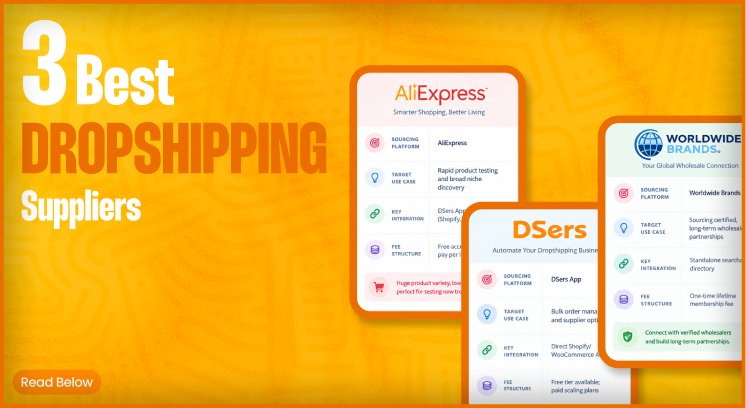
Each sourcing platform offers distinct advantages depending on your budget, target region, and the niche you want to enter.
Let’s break down the three best dropshipping suppliers for successful online brands.
| Sourcing Platform | Target Use Case | Key Integration | Fee Structure |
|---|---|---|---|
| AliExpress | Rapid product testing and broad niche discovery | DSers App (Shopify, WooCommerce) | Free access; pay per item |
| DSers App | Bulk order management and supplier optimization | Direct Shopify/WooCommerce API | Free tier available; paid scaling plans |
| Worldwide Brands | Sourcing certified, long-term wholesale partnerships | Standalone searchable directory | One-time lifetime membership fee |
AliExpress as a Supplier
This huge directory connects dozens of stores with thousands of Chinese manufacturers. It has an enormous variety of goods at unbelievable prices.
It is useful because you do not need to invest any money.
You just add a product to your store and wait for a big order to come in through marketing.
Then you buy the product cheaply from AliExpress. This platform lets you quickly test popular products.
However, delivery via China Post may take a long time. You may spend a lot of time searching for supplier reviews.
DSers Dropshipping App
This software connects the store to AliExpress: customer orders automatically go to the selected supplier.
The major advantage is that one does not have to work with large batches. With this tool, you can cancel any bulk orders.
Also, it is possible to look for alternative providers if the partner does not have enough goods.
This solution makes the work effortless by creating several ready-made product offers, tracking shipped items, and adding tracking links to emails.
The major problem is that the tool may break if external sources change their layouts or remove products and services.
Occasionally, a partner must complete these actions manually.
Worldwide Brands Supplier Directory
Established in 1999, this database provides a verified catalog of reputable factories.
Thanks to this business, one does not have to check whether a supplier is honest or not, since all partners offer top-quality goods.
This solution is valuable because it provides access to trustworthy wholesalers.
The main benefit is that the store sells goods from local warehouses. This means consumers get products quickly and don’t pay much for delivery.
Also, the store will not sell fake or cheap items. The major disadvantage is that an individual must pay a lot for a lifetime certificate.
This supplier suits those who want to work in a niche market.
Strategic Pricing Models: How to Protect Your Margins
An individual should develop a strategy for pricing goods. For instance, the retail price depends on production cost, advertising, shipping expenses, and tariffs.
- Choose a margin that covers all costs, in the range of 30% to 40%.
- Use a markup instead of a fixed percentage.
A small business may utilize the tiered pricing model. For instance, it is possible to use the following strategy:
- Products below $10 wholesale
First, you can apply a high markup percentage, often between 100% and 200%. If a phone case costs $3, it may retail for $12.
This is the base price, and one adds only this rate to payment processing.
- Items between $20 and $50 belong to the mid-range
Secondly, let’s say a custom yoga mat is priced at $20. It can comfortably retail for $35, which costs $40 after a 50-70% markup.
- Products above $100 wholesale
Thirdly, drop the markup percentage down to 20% or 30%. You can position a piece of premium exercise equipment sourced at $200 as high-end.
At $260, the absolute markup is large.
Reality Checks: Risks and Rewards of the Dropshipping Model
Running a dropshipping business is a great way to test demand for goods with no risk or investment.
However, some pitfalls can lead to low profitability or failure.
Painfully Slim Profit Margins
Because you buy each item separately, not in bulk, the per-item price is much higher.
Entering a price war is a big mistake because of the high risk of losing money.
Moreover, one should choose unique goods from a reliable supplier.
You can collect several inexpensive, unique items from different suppliers or build a large catalogue of specialized products.
A good idea is to build relationships with major suppliers to earn discounts through high purchasing volume.
Nagging Return Policy Gotchas
Each supplier has unique return rules.
Some companies allow returns within 30 days, while others limit returns with a 15% surcharge.
So, let’s say a client should receive a product within 30 days of purchase because the US partner can refuse a refund.
In contrast, other companies require consumers to send faulty or defective items back to the manufacturer at their expense.
Moreover, it is essential to offer the same conditions a supplier does.
If the product is expensive and shipping back costs more than the price, a returnless refund is a better option.
Finding Domestic and International Wholesalers
A practical way to build a strong supply source is to check whether products are available in local and international catalogues.
Relying on a single warehouse is risky: a supplier can close, shipping may be delayed, and so on.
Bridging The Gap With Regional Suppliers
Today, many people pay much attention to local suppliers. If most of the audience is in large cities, products arrive quickly because they choose goods from local warehouses.
This strategy helps fulfil orders quickly, and one does not receive complaints and money back.
Furthermore, such a partner has an advantage because high sales and loyal customers promote the store through word of mouth.
A good idea is to work with several suppliers because this is essential to keep up with growing demand.
Tapping Into The Global Supply Chain
You can offer a wide range of goods. You don’t need to spend significantly more on a domestic supplier when your target audience is concentrated abroad.
The worldwide market has enough products.
According to specialists, the dropshipping market will grow from $243.42 billion in 2023 to a projected $476.10 billion by 2026.
Thanks to continuous technological progress, the distance has become much shorter than before.
Moreover, testing new items is now cheaper, and manufacturers offer more and more goods.
As the market grows, everyone needs a strategy for increasing sales.
A good choice is to use international suppliers when launching new items and move them to nearby warehouses as sales volumes grow.
Step-By-Step Vetting Protocol: How To Test A Supplier
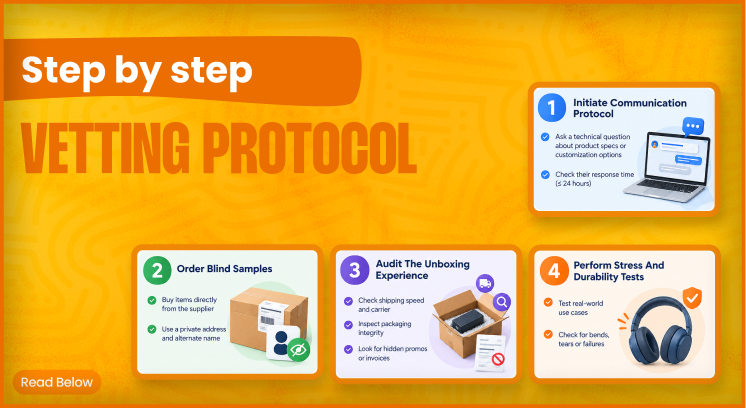
You have to run a potential supplier through a practical stress test before you launch a public marketing campaign
To do that, follow this validation sequence to ensure they can handle real-world order volumes.
1. Initiate Communication Protocol
Firstly, send the vendor a technical question regarding product specifications or customization options.
Also, measure their response time. If they take more than 24 hours to reply, or if their answers are vague, skip them.
2. Order Blind Samples
Second, buy items directly from the supplier using a private address and an alternate name.
Do not reveal that you are an e-commerce store owner.
3. Audit The Unboxing Experience
Third, evaluate the shipping carrier’s speed and inspect the external packaging’s structural integrity.
Also check whether the vendor secretly slipped in promotional materials or invoices that reveal their direct-to-consumer pricing.
4. Perform Stress And Durability Tests
Finally, put the sample product through rigorous use-case scenarios.
If it bends, tears, or fails under normal operating pressure, your customers will face the same issues. Move on to another partner.
Remember: choosing the best dropshipping suppliers takes time, systematic testing, and realistic margin planning.
Once you choose the partners that combine strong product quality, native automation tools, or transparent logistics, you can build a sustainable digital storefront that delivers real value to your audience.