








Launching a hospitality venue involves a complex web of municipal approvals, construction timelines, and supply chain logistics.
The most common reason new bars fail before their first pour is not a bad drink menu; it is regulatory drag.
Signing a commercial lease too early, assuming local paperwork takes only a few weeks, is a frequent, critical error.
When approvals take six months instead of six weeks, operators burn through tens of thousands of dollars in initial capital paying rent on a dark, empty building.
A comprehensive bar business plan serves as an operational shield for your capital.
It is a live document designed to stress-test your business model and reveal hidden vulnerabilities.
Moroever, you can prove to lenders that you understand the hospitality industry’s financial realities.
Quick Summary: The Bar Blueprint Checklist
Short on time? Here is the exact structural sequence a professional plan must follow to satisfy lenders and private investors:
- Executive Summary: A concise one-page overview detailing your concept, target market, and the exact financial ask.
- Concept & Market Analysis: Objective demographic data proving local demand for your specific establishment type.
- Operational Framework: Your daily management structure, software stack, inventory control, and staffing models.
- Licensing Strategy: A clear roadmap and timeline for securing municipal permits and your liquor license.
- Financial Projections: A 3-to-5-year cash flow model, prime cost calculations, and a transparent capital allocation table.
The Executive Summary Is Your Pitch

Lenders and private equity investors see dozens of proposals each week. So the first page needs to be engaging but not generic.
You need to tell the investor:
- What you are building?
- Who the customer is?
- Why you’ll make a profit?
- How much the lender or equity partner needs to provide.
All of this needs to be under 500 words. This is a highly distilled version of your pitch.
You must state the launch cost, when you project profitability, and what backers will earn or receive for their investment.
· The Hook
This should be a specific service gap in your local area.
Not “socializing,” but something more like “the local central business district sports bars but no high-end lounge for after-work drinks.”
· The Financing
The amount of money you’re looking for should be stated clearly on the first page.
And if you are looking for $350,000 in start-up funds, you will put that number in bold at the beginning.
· The Payback
Second, you should explain to the lender or equity investor how they will recoup their investment.
Be sure to explain if it will be structured as a preferred return (until the initial investment has been returned to the investor) or straight equity.
Concept, Vibe, And Market Proof
Investors will not be impressed by a clever concept, a pretty vibe, or a catchy name. The concept is your chance to marry your idea to market realities.
Get very specific about your four essential customers, and don’t dismiss the competition.
Back this up with objective local data: foot traffic, median household income in your market area, and your competitors’ financial performance.
· Matching Concepts to Communities
If you are building a natural wine bar, your potential customer base must have enough disposable income to justify your menu prices.
· Know Your Competitors
If your would-be rivals are busy during peak hours, you should know that-and address it in your operating plan.
If their waitstaff are famously surly on weekends, make sure your POS system doesn’t encourage similar bottlenecks.
• The All-Important Menu Engineering
Include a sample opening menu with approximate ingredient costs. Lenders want to make sure you understand pour costs before they hand you a case of vodka.
The Regulations And Liquor Licensing
Not every business plan includes a section on regulations and liquor licensing. But a good one should.
There should be a separate section on local regulations as they pertain to your concept and projections for how you’ll handle liquor licensing.
Because depending on your locale, you might only be able to get a limited number of liquor licenses.
Alcohol licenses can be bought and sold in an open market, and it can cost hundreds of thousands of dollars in some metro areas.
Or you might just need to apply for a new license at the beginning of the year.
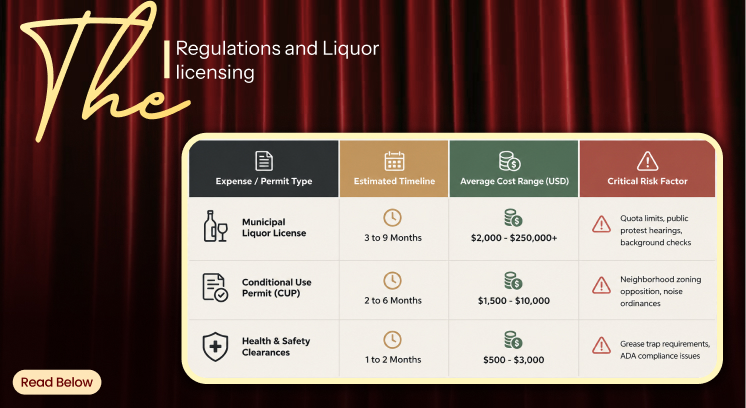
| Expense / Permit Type | Estimated Timeline | Average Cost Range (USD) | Critical Risk Factor |
|---|---|---|---|
| Municipal Liquor License | 3 to 9 Months | $2,000 – $250,000+ | Quota limits, public protest hearings, background checks |
| Conditional Use Permit (CUP) | 2 to 6 Months | $1,500 – $10,000 | Neighborhood zoning opposition, noise ordinances |
| Health & Safety Clearances | 1 to 2 Months | $500 – $3,000 | Grease trap requirements, ADA compliance issues |
Never assume your licensing timeline will go smoothly.
If you do not outline the exact legal path to getting your permits in your bar business plan, experienced investors will assume you are unprepared for the hospitality market.
Always build a substantial time buffer into your launch timeline to account for potential public hearings or bureaucratic delays.
Operations, Technology, and Staffing

An elegant idea without back-of-house operations is useless. This section will explore the operations and the organization of your establishment on a busy Saturday night at full capacity.
Establish a management hierarchy. Let’s say you are a founder with little experience in back-of-house operations in the hospitality industry.
Your plan must demonstrate your intention to hire an experienced General Manager (GM) with a proven track record in prime cost management.
· Inventory Control Systems
Vague guesses during the estimation stage often lead to severe losses due to shrinkage; specify the software (BarTrack, BevSpot, Wisely, etc.) you will employ to track inventory at the level of detail needed to avoid such losses.
· Labor Optimization
Show your adherence to labor cost management principles by designing your weekly staffing schedule based on your bar’s projected revenue during the busiest and slowest hours of the day.
Explain how you will optimize your labor costs during slow afternoons and evening rushes.
Finally, elucidate your supplier network and your GM’s ability to scale purchase volumes without increasing storage space.
The Financial Model (Getting to Grips with Reality)

The financial section of your bar business plan is the most crucial part of all.
It must demonstrate the resilience of your concept, its ability to survive seasonal downfalls, supply chain disruptions, and national economic collapses.
Your financial model should not be overly optimistic about the bar’s ability to generate cash in month one.
Lenders and investors will focus on your prime cost as a percentage of gross revenue and will expect your bar to survive the first month with a cash reserve.
In a nutshell, your prime cost (cost of goods sold + labor) should be no more than 55 – 65% of gross revenue.
· Pour Cost Targets
Set targets for individual categories. For example, draft beer should be 20–25%, liquor and spirits 15–20%, and wine 30–35% of total sales.
· The Cash Reserve
Set aside at least 15% of the total investment as a cash reserve to cover operational losses during the first months.
The Break-Even Point
Calculate the break-even point for your bar. In other words, you need to determine how many drinks and covers
Moreover, the dollars per day your bar should sell to break even monthly and cover fixed costs (lease payments, insurance fees, staff salaries, etc.).
Moving Ahead: What To Do!
Creating a bar business plan takes time, research, and, most importantly, courage.
If the financial section of your plan shows cash deficits in the first year, avoid aggressive changes to the initial figures.
Try revising your pricing strategy, accepting a lower lease payment, or exploring other options.
Next, meet with an experienced hospitality accountant to discuss the local supply chain and cost dynamics.
That said, have a professional review your financial model to ensure there are no gray areas.
At this point, you can take your plan to market and convince stakeholders their money will not be wasted on an ill-conceived project.