








Want to build a profitable bail bond business? Let’s get straight to it. This is not a passive income source.
It is a heavily regulated and high-risk industry. If you make one mistake with a file, then you could lose tens of thousands of dollars.
This is not a generic guide on how to rent an office and make some business cards.
We jump straight into the basics of getting your business set up and how to avoid common pitfalls in your first 12 months.
Quick Summary: The Bare Essentials
Some key points to note:
- You Must Be Licensed: This is a heavily regulated industry. You will need to undertake pre-licensing courses and take a state exam.
- This Can Be Expensive: You will need to invest at least $10,000 to $100,000 to get started, including admin costs, being local to an office, and building the required surety.
- Surety Required: You will never work as a solo agent. You will need to work with an insurance company to back your higher liabilities. In return, you will pay them a percentage of your premium.
- High Risk: If the client does not show up to court and cannot be found, then you are responsible for paying the full bond value.
How Does A Bail Bond Company Actually Turn A Profit?

Bail bond businesses are a niche insurance scheme for defendants if they cannot pay bail.
An agency takes a non-refundable fee of no more than 10% of the bail (as decided under state law) to make a stand to the court that they will pay the entire bail if the defendant doesn’t appear in court.
· Premiums
Bondsmen will rarely receive the full fee. If you are not a solo property bondsman, you will have a surety insurance company.
This means you will have to pay 1-3% of the bail bond face value.
· Build Up Fund (BUF)
Surety companies will also want you to set up a build-up fund.
This is a dedicated escrow account that protects you if you forfeit a bond. You will pay around 1% of every bond you execute into this account.
The money will be held until there is enough to meet a minimum requirement. This minimum is usually between $20,000 and $50,000 and can significantly restrict your cash flow.
Navigating The Licensing And Legal Foundations

Before you spend money on software or lease an office, make sure it is legal to start a bail bond business in your area.
Some states, including Illinois, Kentucky, Oregon, and Wisconsin, do not allow commercial Bail Bonds. They use state deposit systems.
If it is legal to operate in your area, requirements will vary by state.
- Standard States (e.g., California/Florida): Managed by the Department of Insurance. Premiums can only be charged up to 10% (15% for Federal bonds).
- Strict Property States (e.g., North Carolina): Must provide security. Must work with a surety under strict guidelines and state-capped laws.
If it is legal, you must go to your state’s Department of Insurance.
Complete 12-40 hours of coursework related to criminal processes, insurance laws, and ethics.
- Pass a state-administered exam. You will be tested on contract law, signing a power of attorney, and when exonerations happen.
- Have a clean background. You will need to provide fingerprints. If you have a felony or any misdemeanors involving moral turpitude, you will be instantly rejected.
Bail Bond Business: Capital Requirements And True Startup Costs
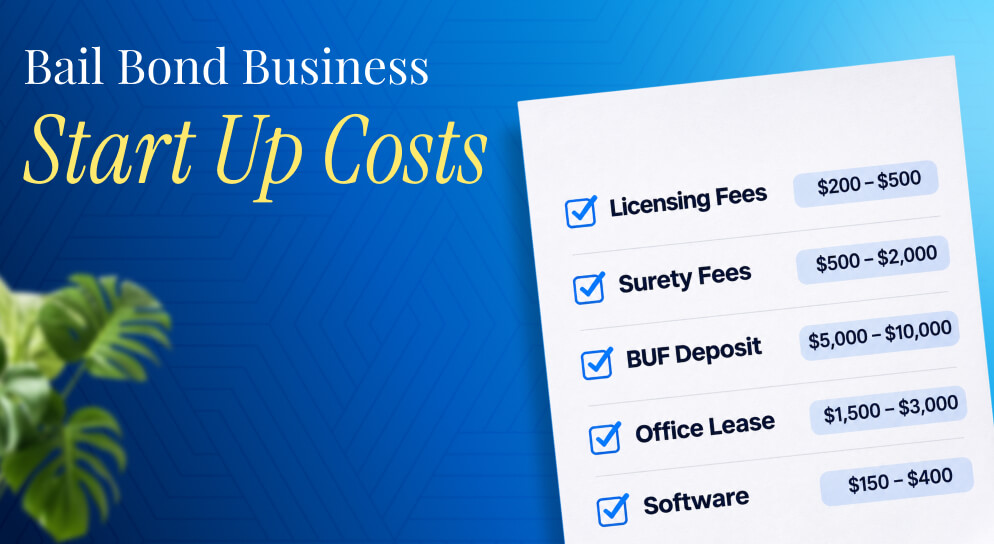
Although online guides say you can get started for just a few hundred pounds, you will need some working capital to set up an operational office.
- Licensing Fees: Between $200-$500, depending on your state’s fees.
- Surety Fees: Between $500-$2000. You will need to pay your insurance company to authorize your powers of attorney.
- BUF Deposit: Between $5000-$10000. You will need to deposit this amount with your surety company.
- Office Lease: Between $1500-$3000 per month. You will not be able to run this from a spare room. Many areas require a physical office.
- Software: Between $150-$400 per month. You will need bail bond software to help you track your clients’ check-ins and court dates.
Location
One of the biggest marketing tools you have in this industry is your location.
Your office should be close to the local county jail or courthouse.
When families are panicking after leaving the visitation center or court, they should see your signage.
If your office is hard to find and you have cheaper rent 5 miles from the courthouse, this is a common beginner’s mistake, and you are almost guaranteed to have no walk-in business.
Why Office Location Is Strategy
In this industry, your physical location is one of your most dominant marketing channels.
Your office needs to sit within a tight, highly visible radius of the local county jail or municipal courthouse.
When families walk out of a visitation center or a courtroom in a panic, your signage needs to be the first thing they see across the street.
A hidden office with cheaper rent five miles away from the courthouse is a classic beginner’s mistake that almost always guarantees a lack of walk-in traffic.
Mastering Risk Assessment and Underwriting
The most important skill you will learn as an agency owner is knowing when to say no. Every bond you write is a gamble that the defendant will turn up to court.
If you underwrite someone unreliable, you could lose everything.
Interview
When interviewing a co-signer or defendant, ask questions to determine whether they are reliable.
- How long have they lived at their current address?
- Do they have a full-time job?
Are they tied down to the local area with family members, or do they have escape routes out of state?
High Value Bonds
If the bond is above $10,000 or relates to serious felony charges, then you will need to ask for property as security.
This should not be jewelry or electronics but clean property equity, clean vehicle titles, or cash.
- If your co-signer offers property, then you will need to check the deed.
Also, check how much they still owe on their mortgage, and make sure all legal owners sign the indemnity.
- If they offer a vehicle title, then you will need to keep the keys and title locked away.
- If they refuse, don’t proceed with the contract.
Local Client Acquisition and Practical Marketing
When someone has a family member in jail, they will not be reading long blogs or scrolling through social media.
They will search for “bail bonds near me”. Or look at the signs outside the jail.
You will need to optimize your local search results. Ensure you are claiming your business on all major map applications. Optimize your profile.
Ensure your business name, address, and phone number are consistent across all platforms.
Try to gain as many positive reviews as possible. These should be detailed reviews from previous clients.
Professional Networking
Outside of targeting customers, this business relies heavily on professional networking.
You will need to network with local defense solicitors, criminal defense paralegals, and legal aid centers.
Lawyers want their clients out of jail so they can easily prepare their defense.
If you can prove your agency can process paperwork quickly, keep information confidential, and doesn’t play games, then they will keep your business cards on their front desk.
Managing Operations, Forfeitures, And Recovery
Once you reach 50-60 active bonds, you’ll get very busy. The last thing you want is someone missing their court date.
You will need to use bail management software such as CaptainBI or BailBooks. This will help you track all of your clients’ upcoming court dates.
Your admin should also have a strict process in place.
- Text 7 days prior to their court date.
- Call 3 days prior.
- Check in 24 hours prior.
Handling the Worst-Case Scenario: Bond Forfeiture
If the defendant misses their court date, then the judge will issue an FTA (failure to appear) warrant.
The judge will also place a conditional asset forfeiture on your bond.
Now the clock starts. Most areas will give you a limited amount of time (usually between 90-180 days) to find the defendant and return them to custody. This will clear your bond.
If you fail to find them within the time frame, then you will have to pay the court the remaining 90% of the bond value.
This is where your insurance, BUF, and cash come into play.
If you were a sloppy underwriter and had multiple forfeitures, then this can cause your young agency to go bankrupt.
Legal Disclaimer: The information in this article is for informational and educational purposes only and does not constitute formal legal, financial, or professional business advice. Bail regulations, licensure frameworks, and corporate legalities vary wildly by state and municipality. Always consult a qualified attorney and your state’s Department of Insurance before launching a business in this sector.