








When you leave a corporate environment and become your own boss, you gain a lot of freedom.
However, this can create issues when you’re trying to buy property or rent. Automated checks are designed for traditional employees.
If you earn via digital transfers and client invoicing, you will need a clear paper trail to prove your income to self-employed lenders.
Underwriters will want clear verification without triggering fraud flags in corporate systems.
Let’s look at what you’ll need in place to create watertight income verification.
TL;DR: The Income Verification Toolkit
If you need to verify your self-employed earnings right now, gather these primary assets immediately:
- Tax Returns: Lenders look for your Schedule C (Form 1040) covering the last two years.
- Bank Records: Up to 12 months of clean statements from a dedicated business account.
- Profit & Loss (P&L): A current snapshot tracking your business revenue against real expenses.
- 1099 Packets: Form 1099-NEC or 1099-MISC packets verifying annual client payouts above $600.
- Tax Transcripts: Request Form 4506-C early, as most institutional lenders pull data directly from the IRS.
Why The Traditional Income Verification Game Shifts When You’re The Boss
Traditional employees will find it easier to get their financing approved.
They provide 2 of their latest pay stubs, and the underwriter verifies how much you’ve earned in gross income (year-to-date).
For self-employed, freelance, and small business owners, this is completely different.
Lenders will want to know how consistent your income will be in the long term. Because your income can vary greatly depending on how many clients you have or how much you earn in seasonal periods, you’ll need to show a strong history.
| Verification Channel | What Traditional W-2 Workers Show | What Self-Employed Founders Must Show |
|---|---|---|
| Primary Document | Automated corporate bi-weekly pay stubs | Comprehensive Schedule C tax filings |
| Historical Horizon | 30 to 60 days of recent employment data | 12 to 24 months of verified tax history |
| Cash Tracking | Consistent, predictable direct deposits | Fluctuating business revenue versus expenses |
The Core Verification Assets: Your Financial Blueprint
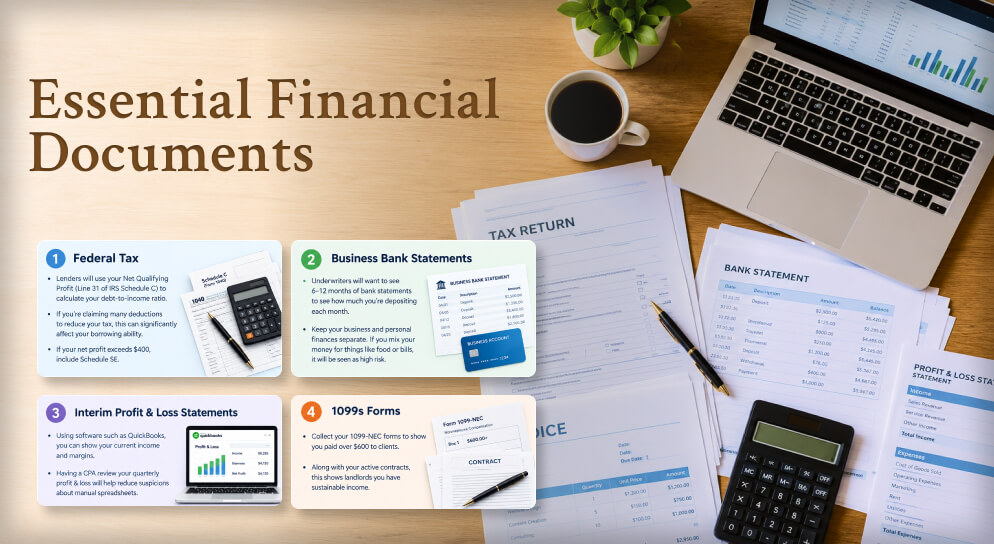
To help your application pass rigorous manual checks, we recommend clean income verification using your tax history and business documents.
· Federal Tax
Lenders will use your Net Qualifying Profit (Line 31 of IRS Schedule C) to calculate your debt-to-income ratio.
If you’re claiming many deductions to reduce your tax, this can significantly affect your borrowing ability. If your net profit exceeds $400, include Schedule SE.
· Business Bank Statements
Underwriters will want to see 6-12 months of bank statements to see how much you’re depositing each month.
Keep your business and personal finances separate. If you mix your money for things like food or bills, it will be seen as high risk.
· Interim Profit & Loss Statements
Using software such as QuickBooks, you can show your current income and margins.
Having a CPA review your quarterly profit & loss will help reduce suspicions about manual spreadsheets.
· 1099s Forms
Collect your 1099-NEC forms to show you paid over $600 to clients. Along with your active contracts, this shows landlords you have sustainable income.
The Underwriting Mindset: Demystifying Lenders and Landlords
To help your applications clear processing hurdles smoothly, you need to understand exactly how risk-analysis experts evaluate your profile.
Lenders generally prefer steady, highly predictable salary lines over fluctuating entrepreneurial income.
To overcome this systemic bias, you must demonstrate real consistency across your business lifecycle.
A clear two-year record of self-employed earnings shows an underwriter that your operation can handle short-term market dips or seasonal shifts.
Underwriters will also verify your history using automated validation tools like the IRS Form 4506-C transcript system.
This lets them pull your official tax transcripts directly from federal servers to confirm the printouts you provided haven’t been modified or falsified.
Legal Realities: Worker Classifications And Regulations
In addition to managing your cash flow, you need to ensure you are compliant.
Fair Labour Standards Act Framework
The Fair Labour Standards Act Framework sets out base pay and overtime protections.
However, this applies only to those legally classified as traditional employees.
As you are an independent contractor running your own company, you won’t fall under this. You will be responsible for setting your own rates, hours and benefits.
Economic Reality Test
State regulators and federal bodies will analyse your worker status using the Economic Reality Test. This will look at the following:
- Profit or Loss: Can you improve your income through strategic investments and decisions?
- Investment: Are you buying your own industrial equipment, specialist software and materials?
- Duration: Are you working on a specific project, or are you working in an ongoing corporate position?
- Control: Are you setting your own structure and method, or are you being micromanaged by the client?
Staying Compliant: Managing Ongoing Self-Employed Tax Rules
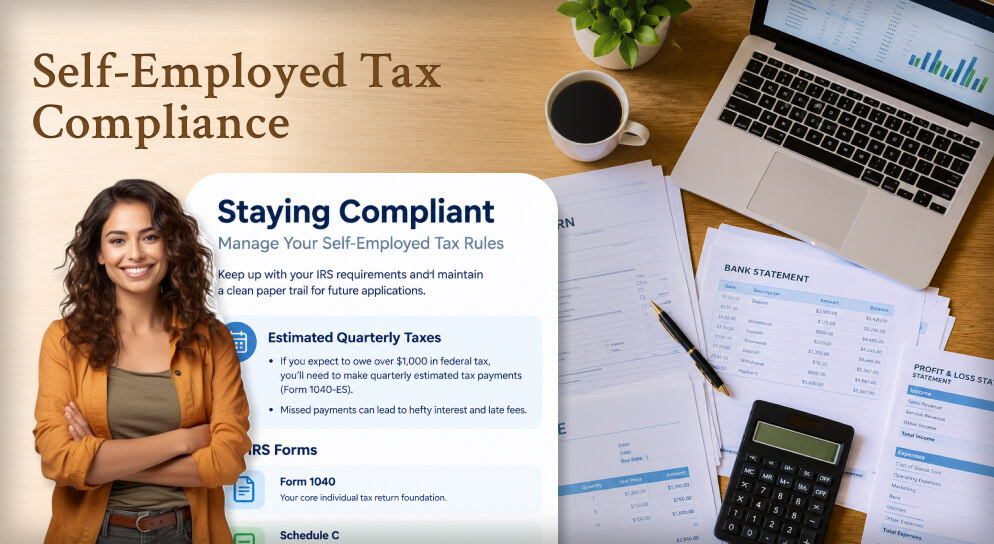
To stay compliant and keep a clean paper trail for future applications, stay on top of your IRS requirements.
Estimated Quarterly Taxes
Unlike traditional employees, whose taxes are taken out of their paychecks, you receive the full amount from your clients.
If you expect to be paying over $1000 in federal tax, you will need to make quarterly estimated tax payments (Form 1040-ES).
If you miss these dates, you could be charged hefty interest and late fees.
- Form 1040: Your core individual tax return foundation.
- Schedule C: The dedicated sheet summarising your business revenues and overhead costs.
- Schedule SE: The calculation sheet tracking your mandatory Social Security and Medicare self-employment tax liabilities.
Spotting Red Flags: Protecting Your Professional Credibility
It’s important to be completely transparent with your documents.
Underwriters review thousands of businesses a year and are trained to spot discrepancies right away.
Corporate compliance teams will look for the following signs to see if your documents have been altered or are unreliable:
We strongly recommend against using any dodgy pay stub generators online.
Many quick solutions will offer clean-looking corporate documents for a small fee.
However, modern underwriters will quickly check these documents against the state’s business register.
If you submit fake or misleading pay stubs, you can get your application blacklisted instantly. In extreme cases, you could face fraud charges.
Use Independent Verification Services
If your landlord uses modern tenant screening software (Snappt, Plaid, or Experian Verify), you can connect your business accounts directly to their system.
This instantly checks your transaction history to confirm your income is genuine. Using this method will instantly gain trust from landlords
A Step-By-Step Guide To The Rental And Loan Application Process
If you’re looking to rent a property or apply for a loan to expand your business, follow these steps.
- Gather your documents: Collect your last 2 years of Schedule C, 12 months of clean bank statements and your current year-to-date P&L.
- Show active client contracts: Show signed contracts or invoices to prove your income next month is secure.
- Show your business license: Show your local municipality certificate or Secretary of State approval.
- Have healthy savings: Make sure you have a large amount saved in your business accounts to show landlords you can easily manage slow payments.
By taking the time to gather these documents, you will feel confident going into any underwriter checks.
Moreover, you’ll help ensure your business runs successfully in the long term by building good habits early to prove your income as a self-employed business owner.
As an independent contractor, keeping accurate records is the most impactful way to ensure your applications are approved in any country.
Disclaimer: This article is for informational purposes only. It should not be considered legal, accounting, tax or investment advice. Lending criteria, tenant screening laws and underwriting criteria can vary. Please consult a qualified CPA or certified financial planner for your specific business setup.