






In the tech world, massive empires rarely start with pristine business plans.
In late 1980, the mighty International Business Machines (IBM) approached a small five-person software company to develop the operating system for its upcoming personal computer.
According to historical contract records archived by the Centre for Computing History, IBM formally brought Microsoft on board to develop the OS in November 1980.
Now, IBM was corporate royalty, while the software company had no operating system and fewer than 40 employees.
IBM offered a simple contract. The small group of programmers took a risk, accepted a small fee to develop the software, and kept the right to license it to other companies.
As reported by PCMag, Microsoft agreed to an upfront fee to develop the system while retaining full ownership of the underlying software code.
Moreover, IBM thought its super high-end hardware was where the money was and didn’t realize this was one of the biggest corporate mistakes ever made.
By including the word ‘Non-Exclusive’ in the contract, the small team could license the same software to IBM’s competitors.
This led to a global clone war, which created a multi-trillion-dollar empire and is an important part of history of Microsoft.
Behind the scenes of history of Microsoft we can learn how to create products you don’t own, use ‘vaporware’, outsmart corporate giants, and use someone else’s innovation to turn a chaotic startup into a fundamental part of modern computing.
Direct Answer: When Did the Founders Invent and Formally Launch Microsoft?
Here are some key points in time for your research:
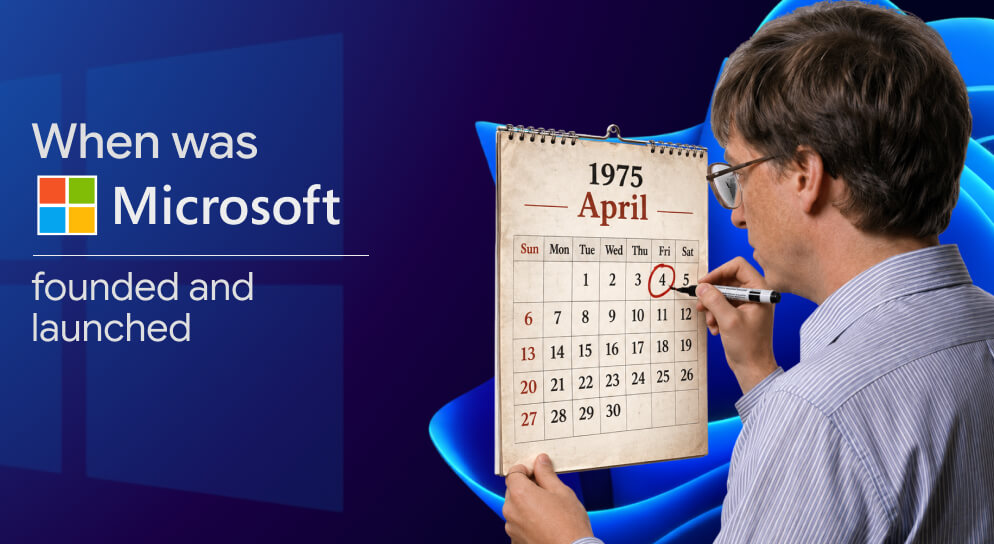
- April 4th, 1975: Bill Gates and Paul Allen officially founded the company in Albuquerque, New Mexico, to write code for the Altair 8800.
- November 6th, 1980: Signed the contract to provide the operating system for IBM.
- November 20th, 1985: Officially launched Windows 1.0.
The Bluffed Prototype: Selling Code for a Machine That Wasn’t There
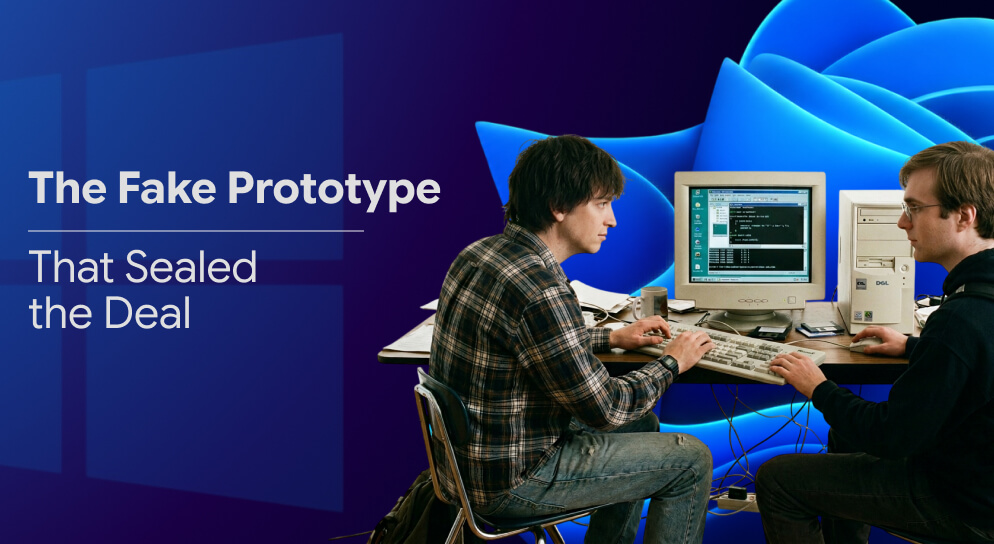
In tech profiles, Bill Gates and Paul Allen are often depicted as super careful, cautious geniuses. However, early in the history of Microsoft, they made their first big breakthrough by bluffing.
In January 1975, Paul Allen saw a picture of the MITS Altair 8800 (the world’s first true microcomputer) on a magazine cover.
According to historical records published in the IEEE Xplore database, this iconic image appeared on the front of Popular Electronics. He called the manufacturer and told them they had already written a working BASIC programming language interpreter for the chip.
In reality, they had written nothing and did not even own an Altair computer.
After MITS expressed interest, they spent 8 weeks frantically writing code in their Harvard lab.
So, Allen had to program a computer in the school to emulate the Altair processor so they could test their code.
When Allen traveled to Albuquerque and loaded the code onto a real Altair using paper tape, it worked the first time perfectly. MITS bought the license, and history of Microsoft began.
Side Hustle Takeaway
Don’t wait for your product to be perfect before seeing if anyone will buy it. You need to pitch your vision to get feedback and see if there is any interest.
Furthermore, you can also use the pressure of having a ‘Yes’ to push you to build your solution.
The $75,000 Arbitrage: Selling Software They Didn’t Actually Own
The 1980 deal with IBM is a legendary cornerstone of Microsoft’s history, but the operational panic behind it is rarely taught to independent developers.
When IBM hired the firm to build their PC’s operating system, Gates accepted the contract despite lacking the software to fulfill it.
Rather than coding a system from scratch under a brutal deadline, they looked for a shortcut.
They found a local developer, Tim Paterson of Seattle Computer Products, who had built a crude system called QDOS (Quick and Dirty Operating System).
According to historical records documented by IEEE Spectrum, Tim Paterson wrote the Quick and Dirty Operating System (QDOS) in 1980 to work with Intel’s 16-bit 8086 microprocessor.
Bill Gates stepped in and quietly bought the rights to QDOS for $75,000.
Moreover, they rebranded the software as MS-DOS, tweaked the code, and delivered it to IBM. Because their contract let them retain the rights, this deal reshaped Microsoft’s history as they went on to license MS-DOS to hundreds of other PC manufacturers.
The software they bought for a small five-figure sum eventually generated billions of dollars in pure royalty streams.
The Side-Hustle Takeaway
Do not waste time trying to invent everything from scratch. Look for rough, functional tools or ignored open-source code that you can legally build upon. Simply repackage and improve what already exists to launch ten times faster than your competition.
The Xerox Interface Shift: Capitalizing on the Innovation of Others
The visual environment of modern computing, using a mouse to click icons, drop-down menus, and windows. is widely credited to either Apple or Microsoft’s evolving history.
However, both giants borrowed the core idea from a completely different corporate entity that failed to see its value.
In the 1970s, researchers at the Xerox Palo Alto Research Center (PARC) invented the world’s first true Graphical User Interface (GUI). (Source: folklore.org)
Xerox executives, focused primarily on selling high-volume copy machines, viewed the digital interface as an expensive, irrelevant science project. (Source: folklore.org)
Both Steve Jobs and Bill Gates visited the facility and recognized that this technology would define humanity’s future.
While Apple rushed to build the Lisa and Macintosh systems based on these visual concepts, Microsoft was undergoing a shift.
Gates realized that if Apple cornered the market on graphical software, text-based MS-DOS would become obsolete. (Source: folklore.org)
Moreover, they immediately began developing Windows, applying the visual concepts seen at Xerox to run as a shell on top of MS-DOS.
So, when Steve Jobs furiously accused Gates of stealing Apple’s ideas, Gates famously replied: “I think it’s more like we both had this rich neighbor named Xerox and I broke into his house to steal the TV set and found out that you had already stolen it.” (Source: folklore.org)
The Side-Hustle Takeaway
Original inventors rarely build the best products for everyday users. Instead of starting from scratch, find brilliant ideas trapped inside complex labs or clunky software.
So be the bridge that cuts through the confusion and makes great tools simple for everyone.
The “Vaporware” Launch: Surviving A Critical Industry Flop
Windows now runs the vast majority of desktop computers worldwide. However, the first version (Windows 1.0) was laughed at and considered a disaster early in Microsoft’s product life.
The company announced it would launch Windows in late 1983. However, due to many redesigns and poor performance, it was delayed for 2 years. Critics called it ‘vaporware’. (Source: Wikipedia and EDN History)
When it was finally released in November 1985, the response was poor.
- No Overlapping Windows: The interface only allowed tiled windows.
- High requirements: Required expensive mouse hardware and more memory than most consumer PCs had.
Tech experts openly criticized the first version of the software, calling it a “pathetic and naive system” and just a demo.
Instead of giving up on the graphical interface, the team took the criticism on board. They spent 5 years improving the platform and eventually launched Windows 3.0 in 1990. It sold millions of copies, and they had a monopoly on the desktop. (Source: Wikipedia)
Side Hustle Takeaway
Your first product launch probably won’t go perfectly. It is completely normal if your version 1.0 has bugs, gets very few users, or receives no attention at all.
Also, don’t assume your idea is a failure just because it started slowly.
The secret to success is to ignore the quiet launch, listen carefully to what your first users say, quickly remove features that don’t work, and keep improving your product until you succeed.
The Killer App Suite: Destroying Market Leaders Through Bundling
In the late 1980s, Microsoft was the king of the operating system. However, they were losing the battle in office software.
Lotus 1-2-3 ruled spreadsheets, and WordPerfect dominated word processing. Their Word and Excel software were struggling.
Instead of trying to compete with these giants, they changed the game with a clever pricing strategy. In 1989, they launched the Office suite. (Source: hypestkey.com)
They bundled together Word, Excel, and PowerPoint (which used to be sold separately at a high price).
They designed the software to work together – You could easily copy and paste charts from Excel into Word.
Corporate procurement teams realized they could purchase the whole package for a fraction of the price of Lotus and WordPerfect.
Within a few years, Lotus 1-2-3 and WordPerfect lost all their market share. (Source: Wikipedia)
The Side-Hustle Takeaway
Never fight industry giants in specific, feature-by-feature battles. Instead, change the game by bundling complementary products or services together.
You will offer incredible value and win users by solving multiple connected problems all in one simple package.
The “Default Value” Trick: The Strategy That Locked In the Market
The secret to Microsoft becoming a global powerhouse wasn’t its software design, but the power of default.
In the late 1980s and 1990s, when people bought a new computer from a company like Compaq, Dell, or HP, they automatically got Windows installed.
They wouldn’t need to go to a store, buy a floppy disk, or work out how to install an operating system.
The founders knew people would use whatever was put in front of them. By targeting the computer manufacturers, they made their software the default for the business world. Competitors struggled to compete.
The Side-Hustle Takeaway
Win the market by making your product the absolute easiest choice. Remove all friction so that using your tool requires zero effort.
So, by fitting seamlessly into the daily habits and tech tools your audience already uses, you become the most obvious option right in front of them.
The Browser Wars And The Anti-Trust Precipice
In the mid-1990s, the executive team faced a huge problem. The World Wide Web was taking off.
A startup called Netscape had launched a browser called Navigator and had gained over 80% of the market.
Marc Andreessen (co-founder of Netscape) famously said the browser would eventually make Windows obsolete, as it would just be a “poorly debugged set of device drivers”.
Bill Gates recognized the threat and, in May 1995, sent out his famous ‘Internet Tidal Wave’ memo. Microsoft quickly developed its own browser, Internet Explorer. However, Netscape had a strong hold. To win, they used their secret weapon: bundling.
They bundled Internet Explorer with Windows and forced computer manufacturers to include it for free. If a manufacturer tried to remove Internet Explorer or use Netscape, they threatened to remove their Windows license. (Source: justice.gov)
Netscape’s market share dropped from over 80% to under 10% within a few years. However, they had gone too far with their monopoly, and in 1998 the United States Department of Justice sued them for antitrust. (Source: justice.gov/atr/us-v-microsoft-courts-findings-fact)
They faced a scary legal battle that could have split up the company. Although they did not split up on appeal, they were stuck in legal limbo for years.
Moreover, they had to dial back their aggressive tactics and let newer tech startups enter the market.
The Side-Hustle Takeaway
Do not be afraid to use your existing audience and assets to launch a secondary product.
However, avoid aggressive tactics that turn off your hard-earned community or spark legal issues. Focus on creating secondary tools that provide enough value to stand on their own.
Conclusion: The Real Blueprint of Tech Empire Building
The history of Microsoft is nothing like the safe, clean story told in modern textbooks.
They didn’t build their multi-trillion-dollar empire by being perfect innovators and playing nicely in the market.
They used high-stakes bluffing, smart legal tactics, and asset purchases to become the world’s default operating system.
As an independent creator, developer, or side hustler, you don’t need the biggest budget, the most innovative idea, or a perfect launch to make a huge impact.
Validate your market early, use underutilized tools, bundle your value, and respect the power of user convenience to build a digital platform that outlasts your competitors and changes your industry forever.