





Have you ever wondered how a simple text message became one of the world’s most powerful communication tools?
Today, millions of people are scrolling through short messages to get the latest news, keep up with their favorite celebrities, and share funny memes.
But this giant was not built with a huge master plan or lots of money. It started off as a last-minute plan within a small failing podcast company in San Francisco.
The history of Twitter is an amazing story that shows how creativity, clever strategies, and learning from mistakes can create a successful side hustle.
Most people believe huge technology companies succeeded on their first attempt.
However, the reality is far more chaotic but also inspiring! A small group of programmers created the town square of the internet with a simple SMS idea.
In this guide, we’ll take you through the whole History of Twitter.
Whether you are studying business, building your own online project, or simply interested in how some of the biggest tech giants have grown, this story has something for you!
We have included a mixture of paragraphs, comparison tables, numbered steps, and bullet points to make the information easy to understand and keep you engaged throughout. We have also included some practical tips for your side hustle!
Direct Answer: History of Twitter
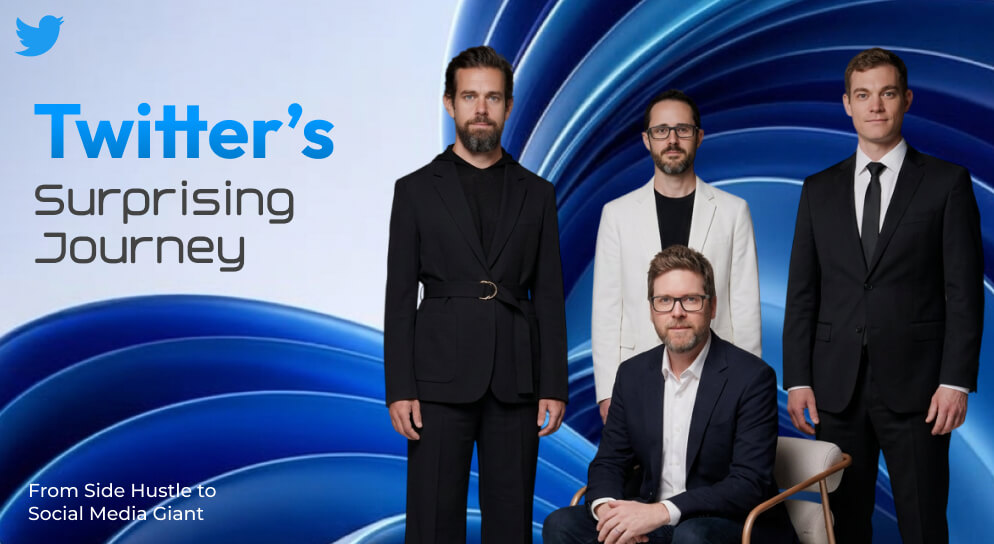
- Who: Jack Dorsey, Biz Stone, Noah Glass and Evan Williams co-founded Twitter inside their podcasting startup, Odeo.
- When: They built the original SMS prototype in March 2006, and the full platform launched publicly on July 15, 2006.
- What: A real-time microblogging social network that originally let users share short 140-character status updates through text messages and the web.
- What Happened: It grew into a global breaking news giant, went public in 2013, and was acquired by Elon Musk for $44 billion in October 2022 before rebranding as X in July 2023.
The Failing Podcast Company And A Desperate Pivot (2004–2006)
All great businesses have a downfall. Evan Williams, Noah Glass, and Biz Stone began a new podcasting business called Odeo in 2004.
They believed it would be the next internet sensation, so they raised millions of dollars to help develop their product.
Unfortunately, in 2005, Apple announced it would add podcasts directly to iTunes. As almost everyone uses iTunes to listen to music, Odeo had lost its main advantage.
The leaders knew they weren’t going to be able to continue their main business so they asked their staff to work in small groups to think of completely new side projects. This resulted in:
- The Pitch: A messaging service using SMS to let friends send short messages about what they are doing. (Suggested by software engineer Jack Dorsey)
- The Name: The original name was ‘twttr’ as vowels were costly in short domain names and SMS codes. (Suggested by co-founder Noah Glass.)
- The First Tweet: Jack Dorsey sent the first-ever post on the platform, saying “just setting up my twttr,” on 21 March 2006.
- Go Public: After testing within the Odeo business for some time, they made the website public on 15 July 2006.
Side Hustle Takeaway
If your initial idea isn’t working, don’t waste years trying to make it work. Like the Odeo team, look at your skills and try some low-cost side ideas.
Moreover, your biggest success could come from a back-up plan you developed in just two weeks!
The 2007 SXSW Explosion and Viral Growth

When Twitter launched, it was very small, with only a few thousand tech nerds using it to update their status about lunch.
Many people didn’t really know why you would want to share your 140-character thoughts with strangers. However, in March 2007, during the SXSW Interactive conference in Austin, Texas, everything changed.
The Twitter team noticed there were thousands of tech bloggers, journalists and start-up founders at the event.
The founders decided not to spend a lot of money on billboards, but instead spent around $11,000 to put up two large flat-screen TVs in the main corridors of the conference center.
Furthermore, every time someone tweeted, their name and tweet would appear on the big screens.
This made everyone at the conference go crazy, as they could see their names on the screen and immediately find out what parties were happening around town.
| Metric | Before SXSW (Early March 2007) | After SXSW (Late March 2007) |
|---|---|---|
| Daily Tweets Sent | ~20,000 tweets per day | Over 60,000 tweets per day |
| Primary Audience | Small group of California tech friends | Bloggers, journalists, and global founders |
| Company Status | Side project inside Odeo | Spun off into an independent company (April 2007) |
Side Hustle Takeaway
You do not need a million-dollar marketing budget to get your first customers. Find the online groups, local events, or communities where your ideal users already gather, and put your product right in front of them.
Users Invent the Best Features (2007–2009)
One of the most interesting parts of Twitter’s history is that many of its features were not actually owned by the company.
When Twitter was first launched, it was just a simple text feed. There was no easy way to categorize topics, message people directly, or share someone else’s post with your followers.
However, because the platform was so simple, users came up with clever workarounds. Rather than disregarding this, the engineers at Twitter created them as official features:
- Hashtags (#): In August 2007, Chris Messina (product designer) suggested that users put a pound sign in front of their words to sort similar topics.
- @Mentions: Secondly, users began adding @ before usernames to message their friends directly. This soon became an official feature.
- Retweets (RT): Also, people began using RT before copying someone else’s brilliant post to share with their friends. This inspired the creation of the one-click Retweet button in 2009.
- Verified Checkmarks: In June 2009, Twitter added blue badges to verify that celebrity accounts were genuine.
Side Hustle Takeaway
When looking at early buyers, always pay attention to their feedback and behaviors. Often customers will show you what features/services they want the most.
Becoming the World’s Breaking News Engine (2009–2012)
By 2009, Twitter had become the fastest way on earth to find out what was going on.
Whether it was an important event occurring, people were using their mobile phones to become the first to report the news. Moreover, they would be much faster than traditional TV reporters.
An example was in January 2009, when a passenger plane made an emergency landing on the Hudson River in New York City.
A man on a rescue boat took a picture of the plane and uploaded it onto TwitPic (a photo-sharing application for Twitter).
Within minutes, the post went viral worldwide. Soon after, Twitter changed the way politics and media worked globally.
In 2011, during the Arab Spring protests, citizens could tweet live updates. In 2012, during the US presidential election, politicians, athletes, and world leaders realized they no longer needed to do interviews in newspapers.
They could make direct communication with millions of voters by simply tapping their smartphone.
Side Hustle Takeaway
In the digital world, people value quick and useful information. Moreover, if you can provide useful information that helps them solve a problem right away, they will trust and follow you.
Going Public And Buying Mobile Video Apps (2013–2015)
As its user base grew into the hundreds of millions, Twitter had to show Wall Street it could make real money.
In November 2013, they went public, and the New York Stock Exchange listed it. This turned the once small side project into a multi-billion-dollar business.
However, to continue growth in the smartphone age, they began acquiring other exciting tech start-ups. There were some changes in leadership.
| Year | Major Milestone | Business Impact |
|---|---|---|
| Late 2012 | Acquired Vine | Introduced looping 6-second videos that launched the careers of dozens of famous internet creators. |
| November 2013 | Wall Street IPO | The New York Stock Exchange listed them, and they went public, raising $1.8 billion in fresh capital. |
| March 2015 | Acquired Periscope | Allowed anyone to broadcast live video straight from their smartphone camera. |
| Late 2015 | CEO Leadership Shift | Co-founder Jack Dorsey returned as CEO after Evan Williams and Dick Costolo led the company. |
Side Hustle Takeaway
Once your side hustle starts making steady cash, do not spend it all on lifestyle upgrades. Furthermore, you need to reinvest a portion of your earnings into better tools, faster software, or new skills that help you reach a bigger audience.
Doubling the Character Limit and Reaching Profitability (2016–2020)
Twitter is well known for its strict 140-character limit. This was because early SMS messages on mobile phones had a 160-character limit, leaving 20 characters for a user’s username.
However, when Flip Phones turned into smartphones, many felt the limit was too short. Twitter made several drastic changes to help increase growth and finally turn a profit:
- Algorithmic Timeline (March 2016): Firstly, instead of the strict chronological feed, they implemented an intelligent feed that displayed the best tweets first. This kept users on the App.
- 280 Character Limit (November 2017): Secondly, they doubled the characters you can put in each post up to 280. This meant you could fully express your thoughts without cutting down on words.
- First Profitable Quarter (Late 2017): After over eleven years of trying to turn a profit, Twitter finally did.
- Increase in Daily Active Users (2020): Lastly, during global lockdowns, daily active users increased dramatically.
Side Hustle Takeaway
You don’t have to stick to how you originally set up your business. If technology or customers change, update your rules to keep your product easy and enjoyable to use.
Live Audio Rooms And Leadership Shakeups (2021)
In 2021, social media trends quickly moved towards voice-based interactions. As audio apps rose in popularity, Twitter launched its own audio feature – Twitter Spaces. This enabled users to create a live audio chat room.
Hosts can invite guests to ‘step up to the mic’ whilst thousands of people listen. Musicians, sports fans and crypto traders all use this feature every night for live shows.
Throughout 2021, the top leadership team saw major changes. In November 2021, Jack Dorsey (co-founder) stepped down for the second time as CEO and handed over to Parag Agrawal (Chief Technology Officer).
At this point, Twitter was trying to make money using subscription models, paid newsletters, and audio.
Side Hustle Takeaway
If you see a new trend coming, such as short videos, audio rooms, or newsletters, then try it out early! You will almost always get the most attention being an early adopter.
Elon Musk’s $44 Billion Takeover And The Rebrand to X (2022–Present)
The most dramatic chapter in the history of Twitter started in early 2022. Tech billionaire Elon Musk quietly began buying shares of Twitter stock until he became the company’s largest shareholder.
Moreover, Musk shocked the business world by offering to buy the entire company for $44 billion, in April 2022.
After months of public arguments, a brief attempt to cancel the deal, and a major lawsuit, the acquisition was completed in October 2022.
Once in charge, Musk took the company private, laid off roughly half the staff to cut costs, and rebranded the entire platform to “X” in July 2023.
| Change Area | Old Twitter Era (Pre-2022) | The X Era (2022–Present) |
|---|---|---|
| Ownership | Publicly traded company on NYSE | Private company owned by Elon Musk ($44B deal) |
| Brand & Logo | Twitter with the widely recognized blue bird logo. | Rebranded to X in July 2023 |
| Verification | Free blue checkmarks for notable figures | Paid monthly subscription for verified badges |
| Core Vision | Real-time microblogging and news feed | “Everything app” with AI (Grok), long videos, and payments |
Side Hustle Takeaway
Platforms change owners, algorithms, and even names overnight. Always use social media to build your own email list, website, or direct customer base so no single company controls your income.
Why the History of Twitter Still Matters Today
Looking back at the history of Twitter, it is amazing to see how much one simple idea changed modern life.
A tiny texting tool built by four friends in 2006 reshaped how journalists report news, how celebrities connect with fans, and how everyday people start online businesses.
Even though the blue bird has been replaced by the X logo, the core lesson remains the exact same: start small, solve a simple problem, listen to your users, and stay ready to adapt whenever the market shifts.